
Clarity Framework
A practical framework for disciplined judgment
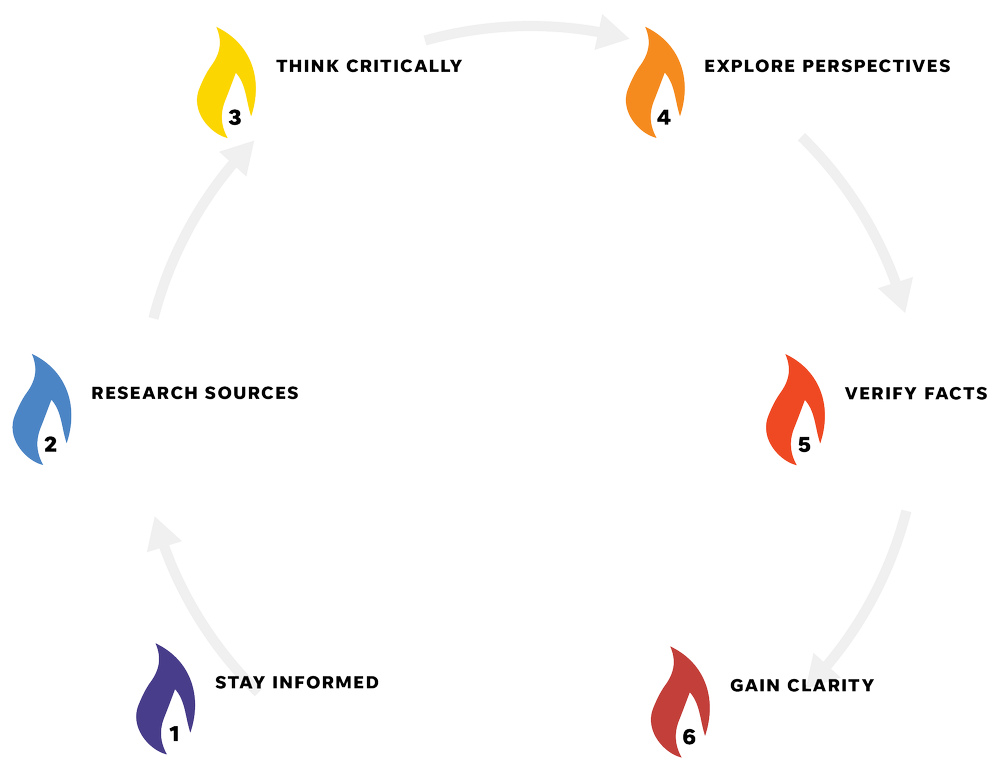
The Clarity Framework™ is a six-stage method for slowing reaction, examining claims, testing assumptions, engaging disagreement, and exercising more disciplined judgment.
View the six stagesThe Practice
Light Your Flame for Clearer Judgment
Use the Framework when a claim provokes an immediate reaction, when trusted sources disagree, when a story feels too complete, or when the consequences of being wrong matter.
Clarity begins not with certainty, but with the willingness to slow down, investigate, and revise what appears true.

Stage 1
Develop Awareness
Awareness begins by recognizing how information, emotion, narrative, and attention influence human judgment.
GoalBegin to Notice the Signals
-
Acknowledge your uncertainty.
Recognize that you might not know the full story—and that’s okay. Awareness begins with humility.
-
Engage your curiosity, not your bias.
Don’t jump to conclusions. Instead, ask open-ended questions: “What’s really going on?”
-
Consume with a wider lens.
Expose yourself to varied sources, perspectives, and informational environments. Compare patterns, omissions, incentives, and emotional framing.
-
Stop reacting immediately.
Slow down. Delay your reactions to headlines or viral content. Give yourself space to think.
-
Listen for silence.
Important signals are often found not only in what is emphasized — but in what is omitted.
-
Track your emotional triggers.
Write down which stories anger, shock, or move you—and revisit them later with a cooler head.
-
Discernment Practice
Begin building a personal discernment practice. Ask:
Does this make sense? What evidence supports it? What assumptions am I bringing into it? Who benefits from this interpretation? What remains uncertain?

Stage 2
Investigate Claims
Investigate how claims are constructed, supported, framed, and repeated before accepting them as true.
GoalTransition from Passive to Active Thinking
-
Compare how claims are framed.
Notice differences in emphasis, omission, emotional tone, incentives, and interpretation across sources and systems.
-
Evaluate incentives and reliability.
Examine expertise, incentives, transparency, institutional pressures, historical accuracy, and evidentiary standards.
-
Verify primary evidence whenever possible.
Interpretations often vary. When possible, examine original sources, underlying data, and direct evidence before adopting conclusions.
-
Track revisions and contradictions.
Pay attention to how narratives evolve over time. Revisions, omissions, reversals, and inconsistencies can reveal important signals.
-
Study historical distortion patterns.
Historical examples of propaganda, institutional failure, information control, and narrative manipulation can reveal recurring human and systemic behaviors.
-
Create a habit of waiting.
Important conclusions often require time. Allow evidence, patterns, and competing interpretations to mature before finalizing judgment.
-
Build an inquiry record.
Document observations, contradictions, emotional reactions, unresolved questions, and evolving interpretations over time. Patterns often emerge gradually.

Stage 3
Analyze Narratives
Examine how narratives, incentives, emotional framing, and institutional pressures shape interpretation before adopting conclusions.
GoalBreak Through Narrative Framing
-
Ask meta-level questions.
Not just what is being reported—but why now? Why this angle? Why this language?
-
Spot narrative scaffolding.
Look for common tropes, recycled talking points, and pre-packaged villains or heroes.
-
Examine emotional framing.
Notice when emotional intensity, imagery, selective emphasis, or symbolic language may be shaping interpretation more than evidence.
-
Seek dissenting voices.
Not just to oppose, but to understand blind spots. Read smart people you disagree with.
-
Recognize false dichotomies.
Be cautious of frameworks that reduce complex issues into rigid binaries, forced loyalties, or emotionally loaded choices.
-
Prioritize discernment over tribal loyalty.
Resist the pressure to adopt conclusions primarily because they reinforce identity, affiliation, or emotional belonging.
-
Begin helping others question respectfully.
Start sharing thought-provoking questions, not just takes.

Stage 4
Engage Disagreement
Engage thoughtfully with differing perspectives in order to strengthen discernment, expose blind spots, and refine your understanding.
GoalActivate Discernment Through Dialogue
-
Ask thoughtful questions openly.
Questions often reveal more than accusations. Curiosity creates space for dialogue where certainty often shuts it down.
-
Create spaces for thoughtful disagreement.
Seek environments where disagreement can occur without performance, hostility, or ideological conformity.
-
Hold your opinions lightly.
Be open to being wrong, and demonstrate that others can too.
-
Recognize coercive persuasion.
Notice when fear, shame, identity pressure, social belonging, or emotional escalation are being used to suppress inquiry or accelerate agreement.
-
Be okay with discomfort.
Challenging groupthink, especially within your own tribe, will trigger emotional pushback. Stay grounded.
-
Resist conformity pressure.
Be cautious when social, institutional, or emotional pressure attempts to override careful inquiry, uncertainty, or independent judgment.
-
Encourage others to stay curious.
Share articles, podcasts, or questions that invite reflection instead of reaction.

Stage 5
Verify Facts
Verify important claims through primary evidence, competing interpretations, and careful examination of context before accepting conclusions as settled.
GoalSeparate Evidence from Interpretation
-
Examine primary sources whenever possible.
Read original documents, full interviews, unedited footage, underlying data, and direct evidence before relying on summaries or interpretations.
-
Recognize emotionally persuasive narratives.
Emotionally compelling interpretations are not always supported by evidence. Learn to distinguish emotional resonance from factual grounding.
-
Apply consistent standards.
If it’s wrong when the other side does it, it’s wrong when yours does too.
-
Clarify contradictions calmly.
Identify inconsistencies, omissions, revisions, and unsupported claims without escalating emotional hostility or certainty.
-
Resist emotional acceleration.
Emotionally accelerated environments often weaken discernment. Slow down before adopting conclusions or amplifying reactions.
-
Recognize narrative timing.
Pay attention to when and why stories emerge, escalate, or suddenly dominate attention. Timing itself can reveal important incentives and pressures.
-
Encourage evidence-based inquiry.
Help others develop habits of verification, context evaluation, uncertainty recognition, and careful interpretation before sharing claims.

Stage 6
Live with Discernment
Discernment is not a final destination, but an ongoing practice of remaining grounded, thoughtful, and reality-oriented amid changing information, uncertainty, and social pressure.
GoalLive with Discernment and Purpose
-
Trust disciplined inquiry over emotional urgency.
Careful investigation, calibrated interpretation, and patient verification are often more reliable than emotionally accelerated certainty.
-
Protect your attention.
Don’t over-consume news. Select your inputs intentionally. Quality over quantity.
-
Stay grounded in enduring principles.
Integrity, humility, human dignity, disciplined inquiry, and careful judgment remain valuable even when informational systems become unstable.
-
Help others without preaching.
Lead by modeling clarity, not by arguing. Ask better questions, and offer tools—not just takes.
-
Stay humble and teachable.
Even at this stage, you’re not immune to bias or blind spots. Keep refining.
-
Create grounded environments around you.
Whether in your home, workplace, community, or online interactions, encourage thoughtful inquiry, emotional steadiness, and careful interpretation.
-
Model discernment quietly.
You do not need to force certainty onto others. Consistent integrity, thoughtful inquiry, and calm judgment often speak more clearly than outrage or performance.