
A book by Jim Detjen
Distorted
The Psychology of Gaslighting, the Power of Story, and the Practice of Clarity
This book is not a manual. It is a lens.
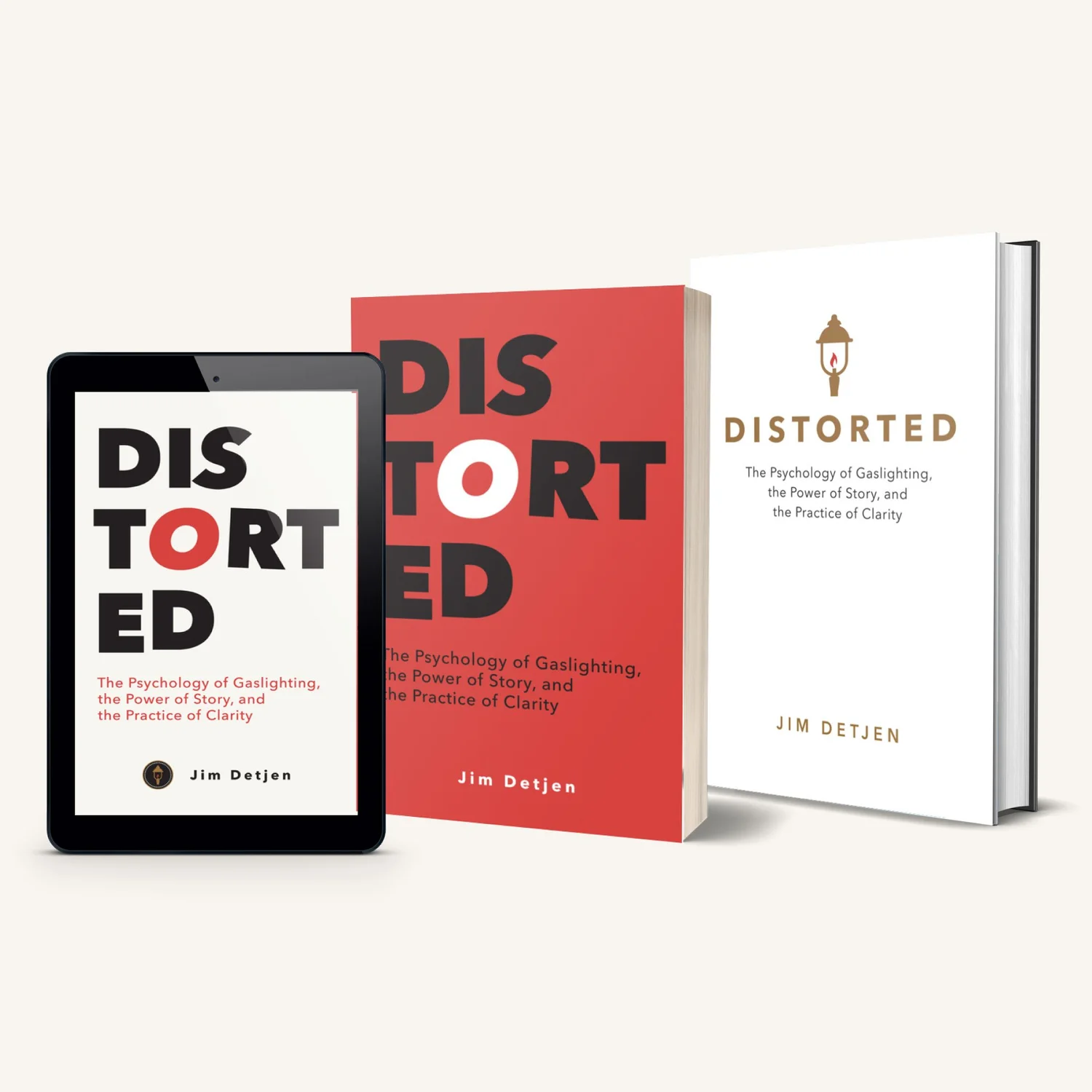
Distorted Jim Detjen
Available now Hardcover · Paperback · Ebook Audiobook in production
The central inquiry
Why do sincere people looking at the same evidence arrive at completely different conclusions?
Before disagreement becomes political, scientific, religious, or cultural, it first becomes perceptual. The stories we inherit, the institutions we trust, and the language we adopt all shape how we interpret reality.
Distorted examines those forces and asks readers to become more responsible for how perception becomes belief.
Gaslighting
The systematic erosion of trust in one’s perception: deny, reframe, repeat.
Poetic truth
The story that feels right but falsifies reality. The lyric that replaces the ledger.
Does this story add meaning—or replace evidence?
Inside 346 pages
Six parts. One widening inquiry.
The book moves from the pattern of gaslighting into the systems that scale it, the human cost it imposes, and the disciplines required to resist it.
The Pattern
The original trick, doubt by design, and poetic truth.
The Systems
Money, memory, media, language, politics, and cultural revision.
The Human Cost
Education, institutional procedure, vanished agreements, and care.
The Engines
Technology, insurance, spectacle, and the narratives of power.
Private Realities
Fringe experience, artificial gaslight, identity, family, and the future sold to us.
Resistance
Evidence, independent voices, courage culture, and the movement toward clarity.
From reading to practice
Explore the ideas
Start with an idea from Distorted, or bring a claim of your own. You can read these in any order.
Guides
Take one idea apart. Follow an example, examine the evidence, and see what you can conclude.
Gaslighting
Follow a disputed deadline. Separate a mistake from a repeated effort to undermine someone’s memory.
Stories and evidence
See when a story helps us understand the facts—and when it starts to replace them.
The sound of authority
Follow a memo through three versions. See which facts and limits survive each edit.
Changing claims
Put the original statement beside later versions. Check what changed and what was explained.
Fluent answers
Look beyond a polished answer. Find its sources and check what they actually support.
Reading the numbers
Compare totals, daily averages, and outcomes. See how a better-looking number can hide an unchanged result.
Questioning our own side
Apply the same fair questions to a claim you welcome and one you doubt.
Future promises
Check the starting point, deadline, and evidence that would show whether a promise was kept.
Looking for a definition? Open the THNK Dictionary.
Practice
Bring something you want to examine. Each worksheet begins with a worked example.
Continuing inquiry
Some questions deserve more than a quick answer.
Questions worth following
Explore six questions about public life, the evidence to seek, and the explanations worth testing.
Audio companion
Distorted is now in the world.
Jim Detjen maps what is inside the book, the questions it carries forward, and how its argument extends into the work of Think First.
Distorted Is Now in the World · Inside the 346 Pages
From book to Think First
The question outgrew the book.
As the manuscript grew, its inquiry moved beyond gaslighting into memory, language, institutions, technology, authority, and the forces that shape judgment.
That wider inquiry became Think First: independent public work devoted to strengthening human discernment.
Distorted · Jim Detjen